The short version is that your route accounting system was built to capture the day, and it does that well. What it was never built to do is read a year of those days and tell you what keeps happening. That second job is what this is.
It sits on top of the system you already run. There is nothing to install, nothing to re-enter, and nothing for your drivers or your office to learn.
The rest of this explains where the idea came from, what it covers, and what it is not.
Why it needed a new name
Every route accounting system on the market is built to capture the day. What was loaded, what was delivered, what came back, who signed for it, who paid, how far the truck went. That work is genuinely well done across this industry. Your invoices are right, your settlement balances, and your books match.
But capturing a day and understanding a year are different jobs, and only one of them has ever had software built for it.
A record tells you what happened. It cannot tell you what keeps happening.
Nothing in the existing vocabulary described that second job properly. Business intelligence is too broad and belongs to a different world. Analytics suggests charts. Reporting suggests more of what you already have. So we started calling it DSD Operational Intelligence, mainly because it needed a name and nothing that already existed fit.
We wrote about that gap in more detail in a companion piece, Your DSD system was built to record the day. It was never built to explain it. It is worth reading if you want the argument rather than the definition.
What it is not
Worth being clear about this early, because most people assume one of four things and all four are wrong.
A dashboard is another way of looking at today, and you already have today covered. It gives you a screen and leaves the thinking to you. This gives you a short list of findings you can act on, which is why it does not end up as another tab nobody opens.
General BI software will chart anything you give it, but it does not know what a stale return is, or why bread that comes back on Monday is a different loss from bread that never left the warehouse. You would spend months teaching it your business before it told you anything useful.
It does not compete with what you run. It reads it. If your current system is working, keep it.
Large distributors solve this by employing analysts. Most family operations cannot justify a full time person to sit and read delivery records, which is precisely why the problem persists in businesses under about twenty routes.
How it works
Three steps, and none of them change how you run the day.
One, it connects to the records you already keep. Deliveries, returns, invoices, credits, payments, route and stop history. You are not asked to enter anything new or record anything differently.
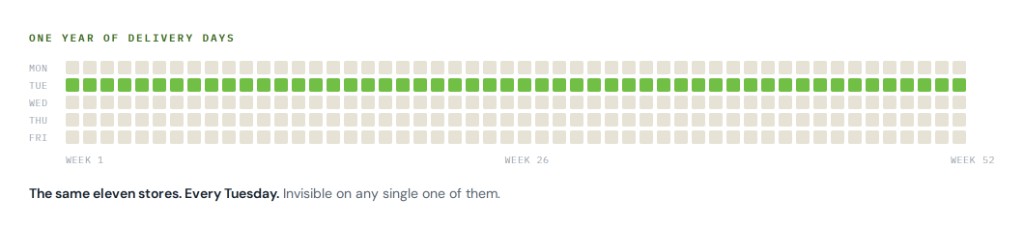
Two, it reads across time rather than within a day. This is the part your current system was never built to do. A stale return in one Tuesday's numbers is an incident. The same return across forty Tuesdays is a pattern, and the pattern is where the money is.
Three, it hands you findings rather than charts. The product, the store, the route, the week, and roughly what it is costing you. Specific enough to do something about on Monday morning.
How DSD Operational Intelligence improves distribution
It covers six areas of the operation. They were not chosen because they were easy to build. They were chosen because they are where money moves without anyone watching.
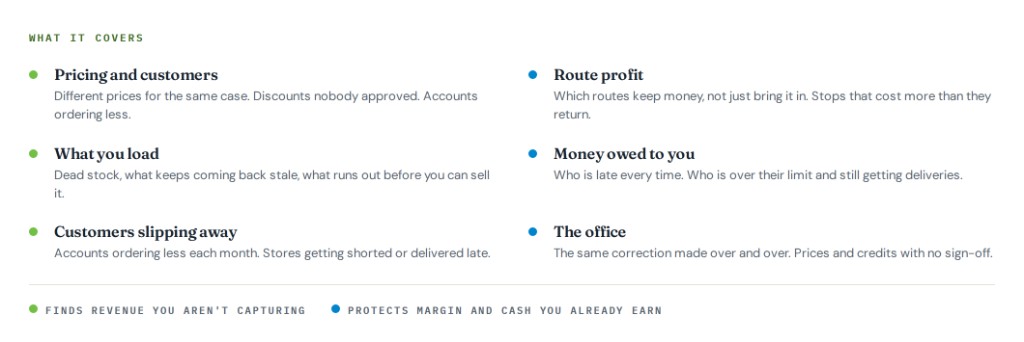
Three of those areas find revenue you are not capturing today. The other three protect margin and cash you have already earned. Most operations have something in all six, which surprises people the first time they see it.
How DSD Operational Intelligence improves route profitability
This is worth taking on its own, because it is the clearest example of the whole idea.
Ask most owners which of their routes is strongest and they will name the one with the highest revenue. That is a reasonable answer, because revenue per route is a number their system puts in front of them every week. Profit per route is a different number, and almost nobody has it.
When you put the two side by side, they are rarely in the same order.
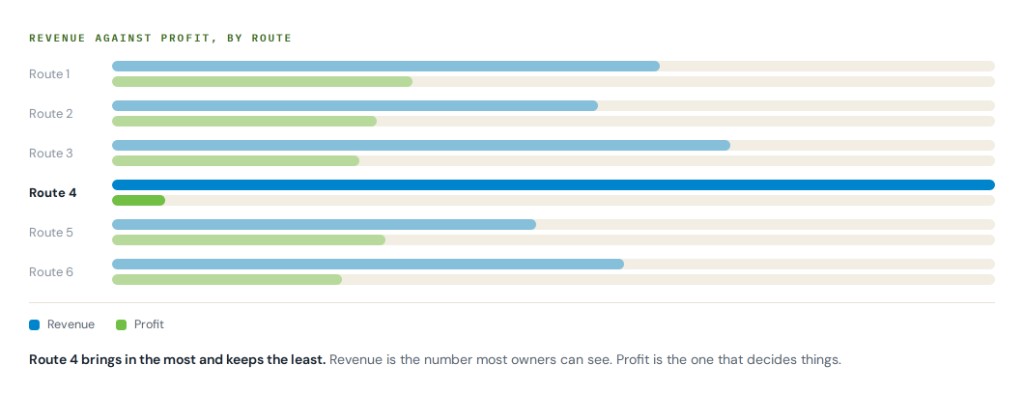
A route can bring in the most money and keep the least, usually because of one or two stops on it that cost more to serve than they return. Those stops do not announce themselves. They sit inside a route that looks healthy from the outside, sometimes for years.
So the improvement does not come from making the trucks faster or the sequence tighter. It comes from telling you which stops were never worth the trip, and which route you have been quietly underinvesting in because its revenue number is unremarkable.
The benefits of DSD Operational Intelligence
Easier to describe as outcomes than as features.
You find money you were already owed. Accounts paying different prices for the same case, discounts nobody approved, promotions still running months after they should have stopped, and customers who are late every single time rather than once.
You stop paying for the same mistake repeatedly. Dead stock, product that keeps coming back stale from the same handful of stores, and stops that have never covered their own cost.
You keep customers you would otherwise lose. An account that is quietly ordering less each month is a phone call today and a lost customer in six months. Nobody calls to tell you they are leaving.
You get your evenings back. If the same correction is being made forty times a month, the problem is not your office. It is whatever keeps causing it, and that is findable.
You make decisions on numbers rather than instinct alone. Not because instinct is bad. Because instinct is excellent on the twenty accounts you know by heart and has nothing to work with on the other hundred and fifty.
DSD Operational Intelligence for distributors of every size
There is an assumption that this kind of thing is for large operations. It is worth pushing back on, because the opposite is closer to true.
A large distributor already has people whose job is to look at this. They have analysts, a finance team, and time set aside for it. A family operation with six routes has an owner who is also the salesperson, the dispatcher, the negotiator, and sometimes the driver when somebody calls in sick.
The smaller the operation, the less spare capacity there is to sit down with a year of delivery records. And on a three million dollar business, a few thousand dollars of recovered margin is a real number, not a rounding error.
The businesses with the least time to look are usually the ones with the most to find.
What it takes to get started
Less than most people expect. Because it reads what you already record, there is no implementation in the usual sense. No migration, no data entry project, no training for the drivers, and no change to how the day runs.
What it does need is enough history to see a pattern repeat, which in practice means months rather than years. A stale return that shows up once is an incident. The same one showing up eleven weeks running is something you can act on.
The honest part
If you have been doing this twenty or thirty years, somebody has sold you something like this before, and it turned out to be a screen you opened twice and forgot about. That is a fair thing to be suspicious of, and we would rather say so than pretend it never happened.
The test is simple enough. If what lands on your desk is a chart, you have been sold a dashboard again. If it is a short list naming the product, the store, the route, and the week, along with what it is costing you, then it is doing the job.
Your system did its part. It recorded the day, every day, for years, and it did that well enough that the answers are already sitting in there.
Somebody just has to read them back to you.