A 3PL warehouse can be busy all day and still have blind spots.
Orders are being picked. Pallets are moving. Trucks are arriving. Customers are using space. Value-added services are being performed. At the end of the month, invoices go out.
Your warehouse system records much of this activity. But recording what happened is not the same as understanding what it means.
That is where 3PL operational intelligence comes in.
Operational intelligence sits on top of the systems a 3PL already uses and turns day-to-day activity into signals that managers can act on. Instead of digging through reports to figure out what needs attention, teams can see where space is being overused, where workflow is tightening, which orders are at risk, and where billable work may have been missed.
Your WMS tells you what happened. Intelligence tells you what it means.
Most warehouse systems do an important job. They record inventory movements, process orders, confirm picks, and maintain activity histories.
The problem is that operational decisions often require information across several of those activities.
Consider a customer that has been using more warehouse space than expected. The WMS may show where inventory is located. It may not make it immediately obvious that the customer has exceeded the space included in their agreement, how long that overuse has continued, or whether it should result in an additional charge.
The same applies to billing.
A value-added service can be completed correctly on the warehouse floor and still never make it onto the invoice.
Operational intelligence connects those dots.
Space is one of the most important numbers in a 3PL
For a 3PL, warehouse space is a product.
If Customer A has contracted for a certain amount of space but regularly uses more, that difference matters. It affects warehouse capacity, customer profitability, and potentially what the customer should be paying.
This becomes difficult to manage when space usage is measured manually or reviewed only at the end of a billing period.
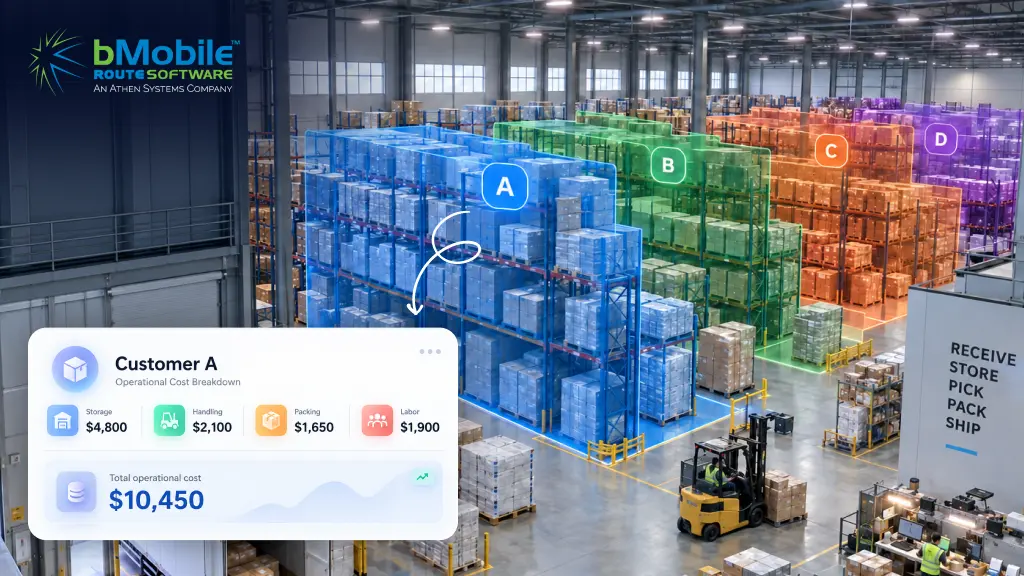
With customer-level space intelligence, managers can see usage by customer, zone, and time period. That makes it easier to identify overuse while there is still time to address it, rather than discovering the problem after the invoice has already been disputed.
Imagine a warehouse where four customers occupy different areas of the facility. One customer is at 92% of contracted space, another is at 78%, while two others are well below their limits.
That tells you more than a warehouse-wide utilization percentage ever could.
You know who is consuming the capacity and where the pressure is coming from.
Warehouse pressure builds before a delay happens
The same principle applies to dock and workflow management.
A delayed shipment rarely appears out of nowhere. Pressure can build in receiving, staging, picking, packing, or outbound operations before anyone formally records a delay.
Maybe inbound volume has increased. Maybe one dock is taking longer to clear. Maybe staging is filling faster than orders are leaving.
By the time a customer asks why their order missed its pickup window, the problem has already moved downstream.
Operational intelligence helps identify those patterns earlier. Instead of simply reporting that a dock is behind, it can show where pressure is building and which downstream orders may be affected.
That gives an operations manager something much more useful than a historical report: a reason to intervene today.
Knowing which orders are at risk
In a 3PL environment, an order being technically incomplete is not always the most important information.
The bigger question is whether it is heading toward a problem.
An order scheduled for a 4:00 p.m. pickup that has not entered the picking queue is different from an order that is already packed and staged.
Both may technically be open. Only one requires immediate attention.
Operational intelligence looks across order activity and workflow to surface those differences. It can highlight orders that are trending toward a missed pickup, identify work queues falling behind, and help managers distinguish recurring operational issues from one-off exceptions.
That gives the team an opportunity to fix the problem before the customer experiences it.
The billing gap is often hiding in plain sight
This is where operational intelligence can have a direct impact on the bottom line.
3PLs perform services every day that go beyond basic storage and order fulfillment. Handling, returns, special packing, value-added services, additional storage, and other activities can all have a charge associated with them.
The warehouse may record that the work happened.
The invoice may not.
That gap is easy to miss when billing depends on spreadsheets, manual reconciliation, or someone remembering to look for every billable event.
Operational intelligence connects warehouse activity with customer agreements and billing rules. It can surface work that was completed but not invoiced, identify rates that may have been applied incorrectly, and provide the usage records behind a charge when a customer questions an invoice.
That is more than administrative efficiency. It is revenue that the 3PL has already earned but might otherwise leave uncollected.
Customer intelligence goes beyond billing
The same operational signals can tell you something about the health of each customer relationship.
A customer experiencing repeated missed orders, billing disputes, or service issues may not suddenly decide to leave. Problems tend to accumulate.
If those patterns are visible early, an account manager has an opportunity to address them before they turn into a larger escalation.
That could mean discussing warehouse capacity, correcting a recurring workflow problem, reviewing service expectations, or simply having a better-informed conversation during a QBR.
Instead of asking, "How is this account doing?" and relying on intuition, the team has evidence to work from.
The real value is connecting the signals
Space, dock flow, order execution, billing, and customer health might sound like separate operational areas.
They are not.
A customer using more space may also be generating more orders. More orders may put additional pressure on picking and packing. That pressure can affect outbound flow. Additional services may be performed along the way. If those services are not captured, the customer can become more expensive to serve without the invoice reflecting it.
Operational intelligence connects those events.
That is what makes it different from simply adding another dashboard to your technology stack.
You don't need to replace your warehouse system
Operational intelligence does not mean replacing the WMS or ERP your team already relies on. Instead, it works with the systems you already have, using the data they generate to give your team a clearer view of warehouse activity, customer usage, order performance, and billing.
The goal is simple: make existing data more useful.
Rather than pulling information from different reports and trying to piece everything together manually, managers can see important patterns and exceptions in one place. That makes it easier to spot issues early, understand what is driving them, and take action before they become bigger operational problems.
Turning warehouse data into better decisions
A 3PL already has a huge amount of operational data. The challenge is making that data useful before an issue becomes a problem.
When space usage, order activity, warehouse workflow, billing, and customer activity can be viewed together, managers get a much clearer picture of what is happening across the operation. They can spot capacity issues earlier, catch missed billables, identify orders that need attention, and understand which customers may need a closer look.
That is the real value of operational intelligence. It turns warehouse activity into information your team can actually use to make better decisions.
bMobile's 3PL Operational Intelligence adds that visibility on top of your existing warehouse systems. It helps your team connect the numbers behind storage, handling, labor, orders, and customer activity so they can spend less time piecing reports together and more time managing the operation.
For 3PLs, better visibility can lead to tighter capacity management, more accurate billing, stronger customer relationships, and fewer operational surprises.
See how bMobile turns warehouse data into better 3PL decisions
Request a Demo