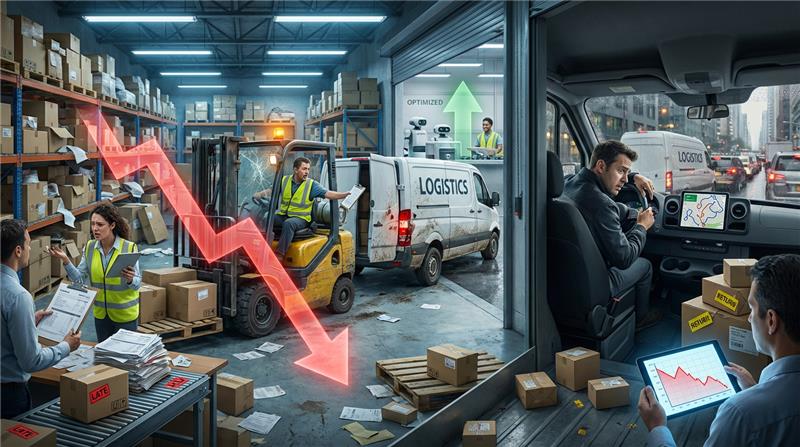
Delivery distributors rarely struggle because of one big failure. It is usually a series of small operational gaps that quietly chip away at margins, service levels, and team productivity.
Now let’s look at where delivery distributors commonly go wrong and what separates high-performing operations from the rest.
Treating routing like a daily guessing game
In many distribution businesses, routing decisions still rely heavily on dispatcher memory and driver familiarity.
It feels manageable. Until volumes shift. Until a customer adds an urgent delivery. Until traffic patterns change. Suddenly the day unravels.
This is where delivery optimization errors take root. Routes built manually often create overlapping territories, uneven workloads, and unnecessary mileage. What looks efficient at first glance ends up costing more in fuel and labor.
Optimized routing is not about replacing dispatchers. It is about equipping them with tools that calculate the most efficient sequence of stops based on real constraints like delivery windows, vehicle capacity, and traffic conditions.
When routing becomes data-driven instead of reactive, performance stabilizes quickly.
Relying too heavily on spreadsheets and paper
Spreadsheets are familiar. Paper proof of delivery has been around forever. But familiarity does not equal efficiency.
Manual processes create friction at every stage. Incorrect addresses. Lost paperwork. Delayed invoicing. Dispatchers fielding constant phone calls to check delivery status.
These distribution mistakes rarely show up as a single dramatic issue. Instead, they surface as small delays, repeated rework, and billing disputes that eat into margins over time.
Digital proof of delivery, automated route planning, and centralized dispatch systems eliminate much of this daily friction. The savings show up in reduced admin time and faster billing cycles.
Operating without real-time visibility
Many delivery distributors cannot answer simple questions in real time.
Where is the driver right now?
Has every stop been completed?
Why was a delivery late?
How long was the vehicle idling between jobs?
Without live visibility, managers rely on after-the-fact reporting or driver phone calls. That makes it hard to correct issues during the day.
Delivery optimization errors often stem from this lack of insight. If you cannot see route performance as it happens, you cannot intervene before service levels slip.
Live tracking and performance dashboards give operations managers the ability to act immediately instead of reviewing problems days later.
Scaling volume without upgrading systems
Growth is exciting. It also exposes weak processes.
A routing method that works for five vehicles may collapse under fifteen. More stops mean more variables. More variables mean more room for error.
One of the most common distribution mistakes is assuming that existing manual systems can simply stretch to handle additional volume. In reality, complexity compounds quickly.
Dispatch becomes reactive. Drivers work uneven hours. Customer service teams handle more delivery complaints.
At that point, technology is no longer optional. It becomes foundational.
Underestimating the financial impact of route inefficiency
Extra mileage does not look dramatic on a single day’s report.
But multiply a few additional miles per route across dozens of vehicles and hundreds of deliveries per week. Add fuel, maintenance, and overtime. The financial impact becomes significant.
Delivery optimization errors often hide in these small inefficiencies. They do not cause immediate breakdowns. They simply reduce profitability month after month.
Route optimization software identifies those inefficiencies automatically and recalculates more efficient stop sequences. Even modest percentage improvements translate into meaningful cost savings over time.
Failing to connect delivery performance with customer experience
Today’s customers expect accurate time windows and clear communication.
If a truck is delayed, they want to know. If a delivery is completed, they expect confirmation.
Yet many distributors operate without structured service metrics. There is no reliable measurement of on-time performance. No automated alerts. No delivery confirmations beyond paper signatures.
This disconnect affects customer retention and competitive positioning.
When routing, tracking, and proof of delivery are integrated, service becomes proactive. Customers gain confidence because the distributor has control over its operations.
Moving from reactive to optimized operations
Across the industry, operational themes repeat themselves. Wholesalers and distributors that cling to manual systems struggle with visibility, cost control, and scalability.
Those that modernize routing and dispatch processes see measurable improvements in fuel usage, labor allocation, and on-time delivery rates.
At bMobile, we work closely with delivery distributors to eliminate distribution mistakes and correct delivery optimization errors through route optimization, live tracking, automated proof of delivery, and performance reporting. The goal is not just better software. It is tighter operational control and stronger margins.
When you can see your fleet in real time, measure route efficiency, and adjust quickly, distribution becomes predictable and scalable.
Stop losing margin to hidden routing inefficiencies
Book a Demo with bMobile