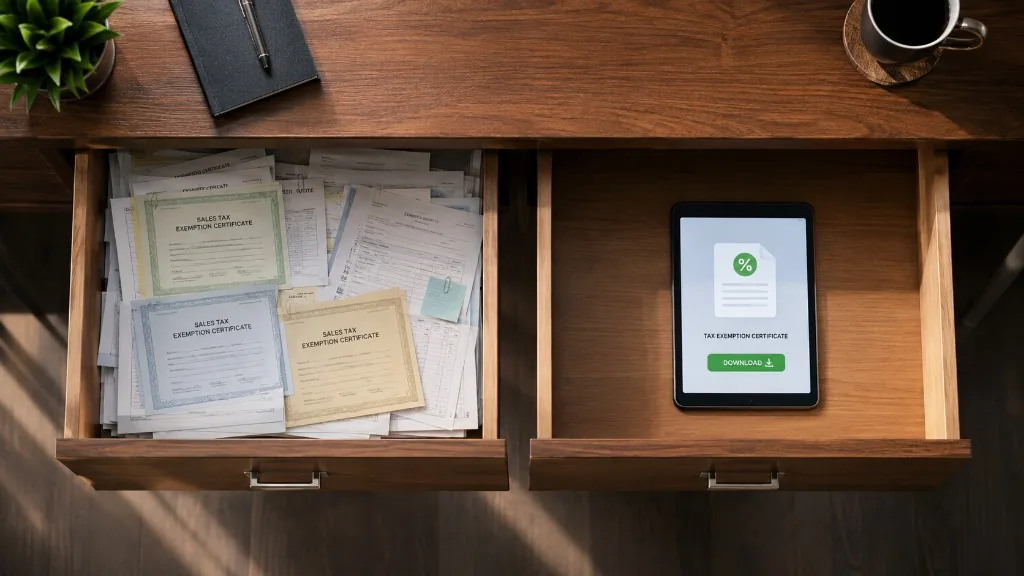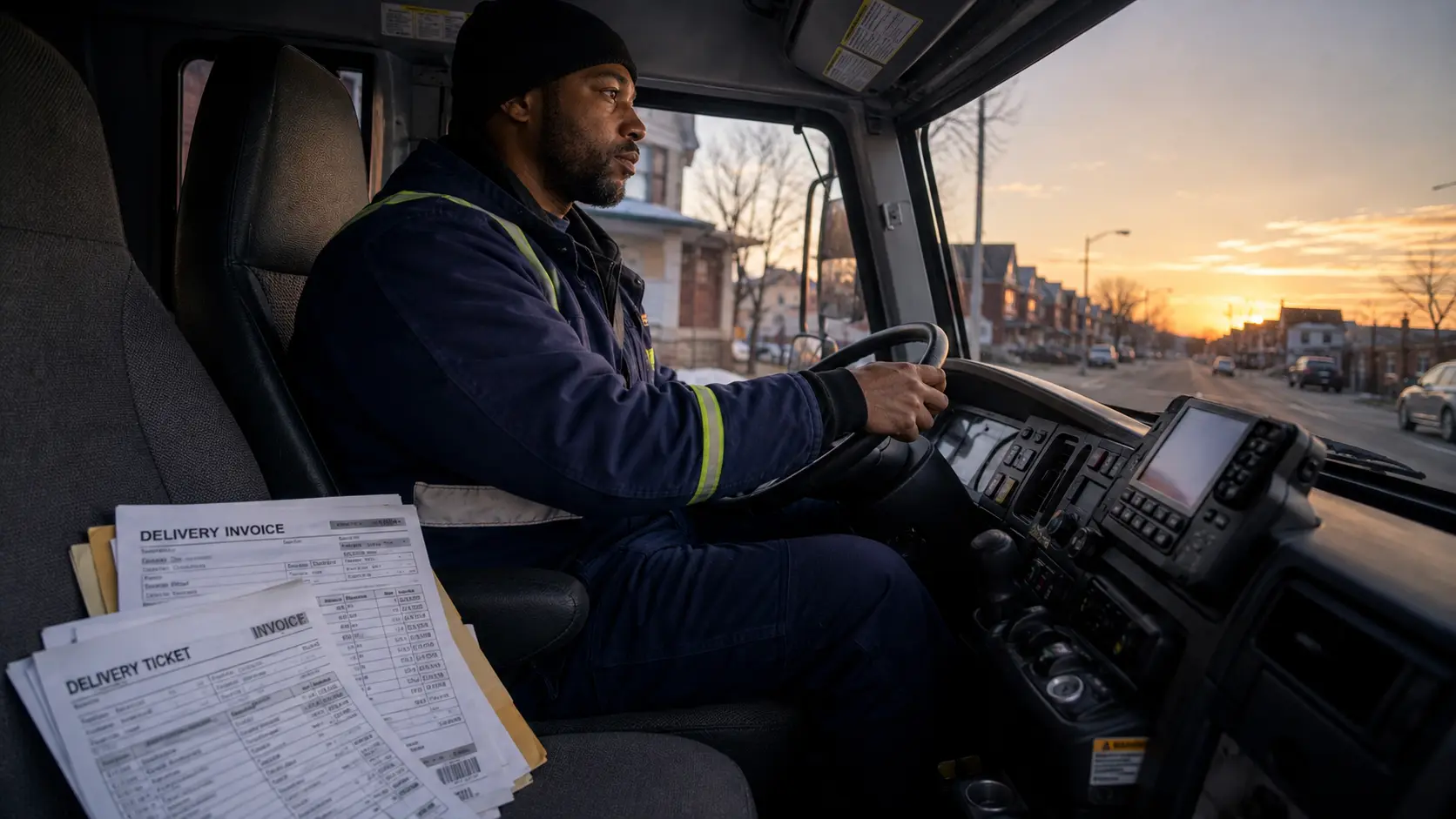
Nobody sits down one morning and says, "You know what? I'm going to rip out my route accounting system today." That's not how it happens. What happens is smaller than that. It's the third time this week your office person stayed late re-entering tickets into QuickBooks. It's staring at your stale returns and knowing you're losing money but not being able to say exactly how much. It's calling your driver twice because you have no idea where the truck is or what it's done since 4 AM.
These things pile up. And at some point, you stop and think: is my system actually helping me, or am I just working around it?
If you run DSD routes for bread, snacks, coffee, tortillas, beverages, or anything that goes from your warehouse to a store shelf, this list is going to feel familiar. Most route accounting software challenges don't show up all at once. They creep in slowly. Here are 10 signs your route accounting software for distributors has become more of a problem than a solution.
1. Your office person is re-typing everything into QuickBooks every night.
This is the one we hear more than anything else. The driver goes out in the morning. Comes back in the afternoon with a stack of handwritten tickets, a bag of cash and checks, and a list of problems. Then someone in your office sits down and re-enters every single line item into QuickBooks. By hand. One invoice at a time.
Think about that for a second. Your driver already wrote down what was delivered. Now your office person is typing the same information again. And half the time, the numbers don't match because the handwriting was hard to read, or a return got scribbled in the margin, or someone forgot to note a credit.
Industry research shows that roughly 86% of small and mid-sized businesses still enter invoice data manually. And every manual invoice costs somewhere around $12 to $16 when you add up the labor, the corrections, and the follow-ups. If you're doing 40 or 50 invoices a day, that's thousands of dollars a week spent on work that shouldn't exist.
If your driver makes a sale and your office person has to re-type it later, your route accounting solution isn't doing its job.
2. You have no clue what's happening on the route until the truck comes back.
Your driver pulls out of the warehouse at 3 or 4 in the morning. And from that moment until he walks back in at 1 or 2 PM, you're in the dark. Did he hit all 30 stops? Did he skip the ones on the south end again? Did he actually visit the new account you told him about? Did he collect from the bodega that owes you for the last two months?
You don't know. You won't know until he gets back. And even then, you're piecing it together from carbon copies and whatever he remembers to tell you.
If you've ever had that moment where you're sitting in your office wondering "what is Eddie doing on Route 4 right now?" and the honest answer is "I have no idea," your system has a gap the size of a delivery truck in it. This is one of the most common route accounting software issues distributors deal with, and most have just learned to live with it.
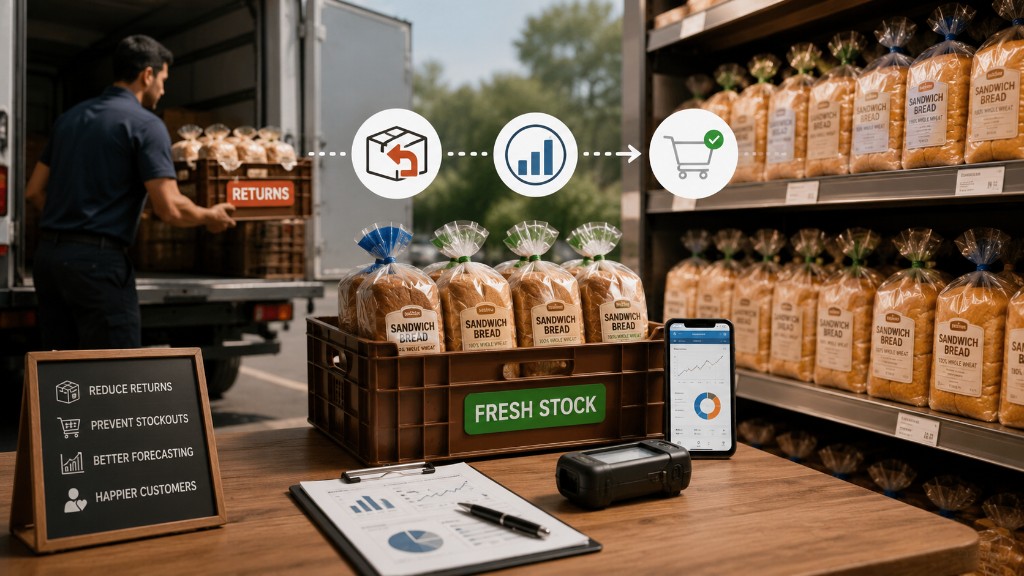
3. You're losing money on stales and you can't pin down exactly where.
If you deliver bread or tortillas, you already know this one in your gut. Fresh product goes bad fast. Bread lasts a few days. Tortillas maybe a week or two. Load too much and it comes back stale. Load too little and the store runs out, and you might lose the account.
Most distributors know their top 20 stores by feel. They know how much Mrs. Garcia's bodega moves on a Friday versus a Tuesday. But the other 150 accounts? That's guesswork. And guesswork adds up.
A bread distributor losing 8% to 12% of product to stale returns is pretty normal. But "normal" doesn't mean it's okay. On a $3 million operation, that's somewhere between $240,000 and $360,000 a year walking out the door as waste. If your route accounting solution can't show you which stores are your biggest offenders and what you should be loading differently next week, you're flying blind on the single biggest margin killer in your business.
4. End-of-day reconciliation feels like solving a puzzle with missing pieces.
Settlement should be straightforward. What left the truck, what came back, what got delivered, and how much money came in. That's it. Four things.
But when you're working off handwritten tickets and carbon copies, it's never that clean. The receipt from Stop 12 is smudged. The return from Stop 18 was written on the back of something. The cash doesn't add up and nobody can figure out where the $47 difference went. Your office person is spending an hour, sometimes two, sometimes three, trying to make the numbers match. And some nights they still don't.
If end-of-day settlement feels more like detective work than bookkeeping, that's not a people problem. That's a tools problem. And it's one of the route accounting software limitations that costs distributors real hours every single week.
5. You can't tell which routes are making you money and which ones are costing you.
Quick question. Can you tell me, right now, which of your routes are profitable? Not which ones bring in the most revenue. Which ones actually put money in your pocket after you subtract the driver's time, fuel, product cost, and returns?
Most distributors can't answer that. And that's a problem, because revenue and profit are not the same thing. Route 3 might bring in $8,000 a week but cost you $7,500 to run. Route 7 might only do $5,000 but cost $3,200. Without that breakdown, you end up pouring resources into routes that look busy but barely break even, while the ones that actually make money get ignored.
If your route accounting software for distributors only gives you totals and can't break it down by route, by account, or by product, you're making big decisions with incomplete information.
6. Your drivers hate the system. Or they've just stopped using it.
Here's something nobody talks about enough. It doesn't matter how many features your route accounting software has if your drivers won't use it.
Bread guys are loading trucks at 2 AM and hitting 30 stops before noon. Snack guys are carrying 80 to 150 SKUs across dozens of convenience stores. Tortilla guys are making product, loading it, and delivering it, all before most people have had their first cup of coffee. These are hard jobs with long hours.
Now imagine telling that driver they also need to figure out a clunky, slow app that freezes every third stop. They're not going to do it. They're going to pull out a pen and start writing invoices the old way. And the moment that happens, you've lost your data, your visibility, and your accountability all at once.
A good route accounting system should make the driver's day easier, not harder. If your drivers are working around the software instead of with it, that tells you everything.
7. It stops working when the signal drops.
This is a big one, and a lot of vendors gloss over it. If you deliver to rural stores, small-town gas stations, bodegas in areas with spotty cell coverage, or pretty much anywhere outside a big city, your drivers are going to lose signal. That's just reality.
So what happens when they're standing at the counter at a store in the middle of nowhere and the app can't connect? Can they still create an invoice? Can they still capture a signature? Can they still process a return?
If the answer is no, if everything freezes up the second the signal drops, then your route accounting solution wasn't built for how route delivery actually works. Your tool has to work on the truck, in a dead zone, with no Wi-Fi. It has to save everything and sync it all back up the moment the connection comes back. Anything less than that is a dealbreaker for real field operations.
8. Your store owners are starting to expect things you can't offer.
Even the small guys, the independent grocery stores, the corner bodegas, the mom-and-pop delis, they're changing. They want to place orders from their phone instead of waiting for the driver to show up. They want an emailed invoice, not a carbon copy. They want to know roughly when the truck is coming so they're not standing around waiting.
This isn't unreasonable. Frito-Lay, Bimbo, the big national DSD operators, they already offer this kind of experience. And your store owners see it. They compare.
Your personal relationships with those store managers still matter. They always will. But when a competitor can let the store reorder from a link on their phone at midnight, and you're still relying on the driver to take the order when he walks in, the gap starts to show. If your route accounting software can't help you offer even basic digital ordering or delivery updates, you're slowly losing ground to people who can.
9. Regulations are tightening and you have no way to keep up.
The FDA's food traceability rule, FSMA 204, has a compliance deadline of July 2028. It requires anyone who handles certain foods to maintain detailed tracking records through every step of the supply chain. Lot codes, product descriptions, quantities, dates, locations. The works.
For a big company with a compliance department, that's a project. For a family distributor running 10 routes with no compliance person on staff? That's a headache you haven't even started dealing with yet.
And it's not just federal. California now requires folic acid fortification in corn tortilla flour. Labeling rules vary state by state. If a retailer asks you for traceability records and you can't produce them, that's not just embarrassing. It could mean fines, product holds, or a lost account.
If your current route accounting software for distributors can't generate proof-of-delivery records, track lots, or produce compliance documentation on demand, you're exposed in a way that's only going to get worse.
10. You've built so many workarounds that the workarounds have workarounds.
This might be the most honest sign on the list. You know the system isn't great. You've known for a while. But you've made it work. You've got a spreadsheet for tracking stales. A paper log for driver hours. A separate notebook for customer credits. A whiteboard for tomorrow's load plan. And QuickBooks holding it all together with duct tape and prayers.
The thing about workarounds is they feel free. Nobody sends you a bill for the extra hour your office person spends every night. Nobody invoices you for the profit you can't see because your route data is scattered across five different places. But that cost is real. It shows up in the overtime. It shows up in the product you threw away. It shows up in the driver who quit because the job was harder than it needed to be.
At some point, the cost of keeping your current setup is higher than the cost of switching. And if you're being honest, that point probably passed a while ago.
Alright, so what do you actually do about it?
If four or five of these signs hit close to home, here's a simple way to start thinking about a switch. No pressure. Just practical steps.
Write down your top three frustrations.
Don't start with software features or vendor websites. Start with what bugs you most. Is it the nightly re-keying? The stale tracking? Not knowing where the truck is? The reconciliation mess? Get clear on what's actually broken before you go shopping for fixes.
Talk to other distributors.
Forget the vendor demos for a minute. Call someone who actually runs routes and ask them what they use. What works. What doesn't. What they wish they'd known before they switched. The best advice you'll get comes from someone who loads a truck at 3 AM, not someone who builds slide decks for a living.
Ask for a demo that looks like your actual day.
Any vendor worth your time should be able to show you a full delivery cycle: load the truck, drive to a store, deliver product, handle a return, print an invoice, capture a signature, and show you the settlement numbers at the end. If the demo takes 10 minutes and you think "that's exactly what I do, but without the headaches," you're onto something.
Ask about offline.
Say those exact words. "What happens when my driver has no signal?" If the vendor hesitates, stutters, or starts explaining a "partial offline mode," keep looking. It either works offline or it doesn't. There's no middle ground for a bread guy delivering to 35 stops before noon.
Check the QuickBooks connection.
This one's non-negotiable. The whole point is to stop re-keying data. So your new route accounting software has to push invoices, payments, and credits straight into QuickBooks (or Sage, or NetSuite, or whatever you're using). Not through a CSV export. Not through a manual upload. Directly. If it can't do that, it hasn't solved your biggest problem.
Replacing your current setup is a big move. Nobody's pretending it isn't. But so is losing money every week to stales you can't track, routes you can't measure, and reconciliation that eats up your evenings. The right system isn't going to ask you to change how you run your business. It's just going to take the paper, the guesswork, and the three hours of re-keying out of the picture.
And for most distributors, that alone is worth it.
Ready to see what a modern route accounting system actually looks like?
Request a Demo